Privacy can be difficult to guarantee in public and commercial environments, particularly in sensitive areas such as restrooms. Restroom bug sweeps are designed to help identify potential surveillance devices, unauthorized listening equipment, and other privacy threats that may have been placed in an area without permission. For businesses, property managers, organizations, and individuals concerned about privacy, understanding how these inspections work can be an important step toward creating safer and more secure environments.
Restrooms are expected to provide a reasonable level of privacy. However, small surveillance devices can sometimes be concealed inside everyday objects, fixtures, electrical components, or decorative elements. Because some devices are extremely compact, they may not be obvious during a casual visual inspection.
A professional privacy inspection can therefore provide an additional layer of reassurance when there are legitimate concerns about unauthorized monitoring.
Why Restroom Privacy Deserves Attention
Restrooms are among the most privacy-sensitive areas in any property. Unlike offices, lobbies, or reception areas, people generally expect conversations, movements, and activities inside a restroom to remain private.
Unfortunately, privacy can be compromised when unauthorized recording or monitoring equipment is installed.
Several factors make these spaces worth inspecting:
- Numerous electrical fixtures can provide concealment opportunities.
- Small objects can potentially hide miniature cameras or microphones.
- Lighting and ventilation fixtures may create additional hiding locations.
- Wireless devices can sometimes operate without obvious physical connections.
- A conventional visual inspection may not identify every type of device.
For these reasons, privacy assessments should be approached systematically rather than relying solely on what can be seen.
What Are Restroom Bug Sweeps?
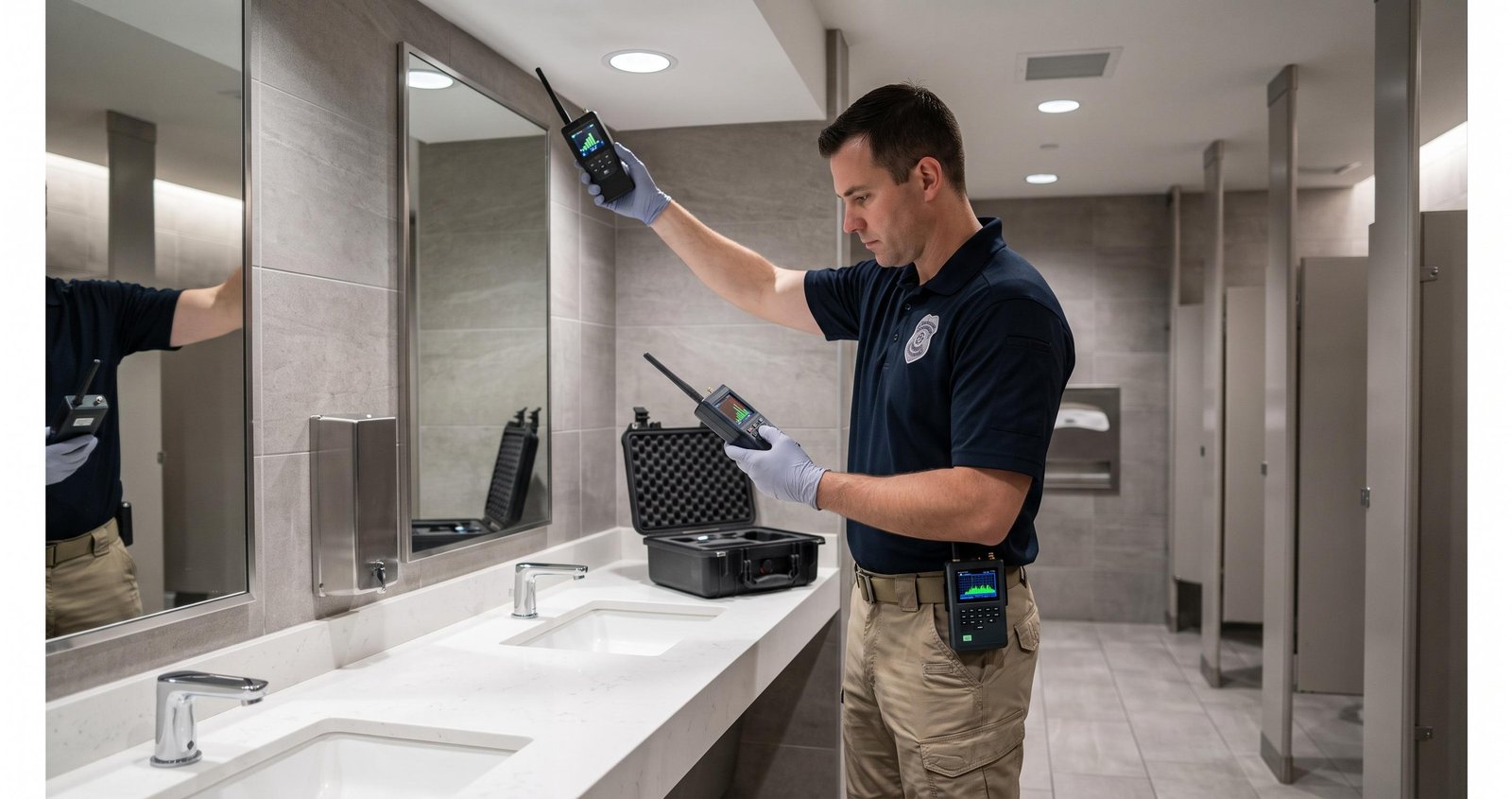
A bug sweep is a technical inspection intended to identify potential surveillance or monitoring equipment within a particular environment. In the context of restrooms, the inspection is focused specifically on privacy-sensitive spaces.
Restroom bug sweeps may involve a combination of visual examination and technical detection methods. The exact approach depends on the environment, the suspected threat, and the equipment being used by the inspection professional.
The objective is not simply to search for a hidden camera. A properly conducted inspection may consider different categories of potential surveillance technology, including:
- Wireless transmitting devices
- Hidden cameras
- Audio monitoring equipment
- Unauthorized recording devices
- Suspicious electronic components
- Devices connected to existing electrical systems
It should be understood that no single detection method can guarantee that every possible device will be found. Different technologies leave different types of physical or electronic signatures, which is why layered inspection methods are generally more appropriate.
Where Could Hidden Devices Be Concealed?
A surveillance device does not necessarily have to look suspicious. Modern technology can be made extremely small, and ordinary objects can potentially be modified to conceal electronic components.
During a legitimate privacy inspection, attention may be given to areas such as:
Lighting Fixtures
Ceiling lights and other lighting fixtures can provide concealment opportunities because they are already positioned in locations with a broad view of the room.
Ventilation Areas
Air vents and ventilation components may be examined for unusual modifications, wiring, or objects that do not appear consistent with the original installation.
Electrical Outlets
Electrical outlets and surrounding components can be inspected for signs of tampering or unauthorized modifications.
Decorative Objects
Items that appear out of place or have recently been introduced into a restroom may deserve additional attention.
Ceiling and Wall Components
Unusual holes, recently altered fixtures, or unexplained wiring can sometimes indicate that an area has been modified.
However, an unusual-looking object should not automatically be treated as evidence of surveillance. Professional verification is important before any conclusion is made.
How Are Restroom Bug Sweeps Conducted?
The inspection process can vary considerably depending on the location and the type of concern involved.
A professional assessment may begin with an interview or site discussion. Information about suspicious activity, recent renovations, unexplained objects, or previous security concerns can help determine where additional attention may be appropriate.
The physical inspection can then be performed systematically.
1. Initial Visual Inspection
The environment is examined for objects, fixtures, wiring, or modifications that appear inconsistent with the original design.
This step is important because physical evidence can sometimes provide context that electronic detection alone cannot.
2. Technical Detection
Specialized equipment may be used to identify certain electronic signals or other indicators associated with surveillance technology.
Depending on the circumstances, multiple detection techniques may be used rather than relying on a single instrument.
3. Physical Examination
Where appropriate and legally permitted, suspicious fixtures or objects may be examined more closely.
Any inspection should be performed carefully so that legitimate building systems are not damaged.
4. Documentation
Findings can be documented through notes, photographs, measurements, and other appropriate records.
Documentation is particularly useful when an inspection is being conducted for a business, property manager, or organization that needs a formal record of the assessment.
Why Professional Inspections Can Be Valuable
DIY searches can be useful for identifying obvious warning signs, but they have limitations.
A person without specialized training may not recognize the difference between legitimate building equipment and modified electronics. False positives can also create unnecessary concern.
Professional inspectors may have access to specialized detection equipment and established inspection procedures.
The quality of an inspection also depends on the experience of the person conducting it. Equipment alone does not replace knowledge. Signals can come from legitimate sources, and unusual objects may have completely innocent explanations.
For that reason, findings should be interpreted within the context of the entire environment.
Signs That May Justify a Privacy Inspection
There is no single sign that proves a restroom has been compromised. However, several unusual circumstances may justify taking privacy concerns seriously.
These can include:
- Unexplained electronic equipment
- Newly installed objects with no obvious purpose
- Unusual wiring or modifications
- Fixtures that appear damaged or altered
- Evidence of unauthorized access
- Repeated concerns about unexplained monitoring
- Suspicious devices discovered during routine maintenance
If something appears suspicious, it should be documented rather than immediately dismantled.
In some situations, the device itself could be evidence of unauthorized activity. It may therefore be preferable to preserve the scene and seek appropriate professional or legal assistance.
Restroom Sweeps for Businesses and Property Managers
Businesses have additional reasons to take privacy concerns seriously.
Commercial properties may contain employee restrooms, customer restrooms, changing areas, or other spaces where privacy expectations are especially high.
Property managers can consider periodic security assessments when appropriate, particularly after:
- Renovation work
- Changes in contractors
- Security incidents
- Unauthorized access
- Reports from employees or visitors
- Discovery of suspicious equipment
A documented inspection process can also demonstrate that privacy concerns are being taken seriously.
At the same time, inspections should always respect applicable laws, building regulations, and individual privacy rights.
What Should You Do If a Suspicious Device Is Found?
Discovering a suspected surveillance device can be unsettling. The immediate response should be measured and careful.
Avoid damaging or unnecessarily handling the suspected device. Instead, document its location and appearance if it is safe to do so.
Depending on the circumstances, appropriate steps may include:
- Restricting unnecessary access to the area.
- Documenting what was discovered.
- Contacting qualified security professionals.
- Notifying responsible property management.
- Contacting law enforcement when appropriate.
- Preserving potential evidence.
The appropriate response will depend on the situation and local laws.
It should also be remembered that not every electronic object is a surveillance device. Verification should be obtained before accusations are made against an individual, employee, contractor, or property owner.
How to Reduce Privacy Risks
Technical inspections are only one part of a broader privacy strategy.
Property owners and managers can reduce risks by controlling access to sensitive areas and maintaining accurate records of contractors and maintenance work.
Practical measures include:
- Restricting unauthorized access to restrooms and sensitive areas.
- Maintaining clear contractor access procedures.
- Inspecting newly installed fixtures.
- Recording maintenance and renovation activities.
- Investigating credible privacy complaints.
- Reviewing physical security periodically.
- Training relevant staff to recognize unusual modifications.
Preventive measures can make unauthorized changes easier to identify.
Choosing a Restroom Bug Sweep Professional
If a professional inspection is required, the provider should be evaluated carefully.
Look for an inspector who can clearly explain the inspection methodology rather than simply promising that every hidden device will be detected.
Important considerations include:
- Relevant technical experience
- Clear inspection procedures
- Appropriate detection equipment
- Professional documentation
- Transparent pricing
- Confidential handling of findings
- Understanding of privacy and applicable laws
Be cautious of providers who make unrealistic guarantees. No legitimate technical inspection should be presented as an absolute guarantee that every possible surveillance technology will be discovered.
A credible assessment should explain both what was inspected and the limitations of the inspection.
The Importance of Regular Privacy Awareness
Privacy protection should not begin only after a suspicious incident occurs.
Organizations and property managers can benefit from developing a broader security culture where unusual modifications and credible concerns are reported appropriately.
Regular awareness can help people recognize changes in their environment without creating unnecessary fear.
For high-risk or particularly sensitive environments, restroom bug sweeps may form part of a broader technical surveillance countermeasure strategy. They can be combined with physical security reviews, access controls, staff awareness, and appropriate incident-response procedures.
The goal should be prevention, responsible detection, and proper response rather than simply searching for hidden devices after something goes wrong.
Final Thought
Privacy in restrooms should never be treated as an afterthought. While no inspection method can guarantee that every possible surveillance device will be detected, restroom bug sweeps can provide a structured way to investigate legitimate privacy concerns and identify potential technical threats. Whether the inspection is being considered for a commercial property, workplace, public facility, or another privacy-sensitive environment, a professional and methodical approach is usually more reliable than relying on casual visual checks alone. When suspicious equipment is discovered, it should be documented and handled responsibly, with appropriate professional or legal assistance sought when necessary.



 Spanish

 English
 Arabic
 French
 Portuguese
 Deutsch
 Turkish
 Dutch
Dutch
 Italiano
 Russian
 Romaian
 Portuguese (Brazil)
 Greek
Greek