Choosing the right offshore structure can be an important decision for international investors, entrepreneurs, and businesses looking to organise investments, subsidiaries, or eligible assets through a UAE-based corporate structure.
Two options that may come under consideration are RAK International Corporate Centre (RAK ICC) and Jebel Ali Free Zone (JAFZA) Offshore. Although both can support international corporate structures, they have different frameworks, features, and potential use cases.
When comparing RAK ICC vs JAFZA offshore company, investors should look beyond incorporation costs. The right choice depends on the purpose of the company, ownership structure, assets, international activities, banking requirements, and long-term business objectives.
What Is RAK ICC?
RAK International Corporate Centre (RAK ICC) is an international corporate registry in Ras Al Khaimah, UAE.
RAK ICC companies can be used for various international corporate purposes, including:
- Holding companies
- International business
- Investment holding
- Special-purpose vehicles
- Joint ventures
- Family-office structures
- Wealth and succession planning
RAK ICC provides several corporate forms, including companies limited by shares, companies limited by guarantee, and unlimited companies.
For businesses and investors seeking a flexible international holding structure, RAK ICC can be worth considering.
What Is a JAFZA Offshore Company?
JAFZA Offshore is an offshore company framework associated with Jebel Ali Free Zone in Dubai.
JAFZA states that its offshore companies can be used for purposes including international trade, holding companies, real estate ownership, intellectual property registration, and international consulting services.
JAFZA offshore companies are established through registered agents and are subject to specific incorporation and documentation requirements.
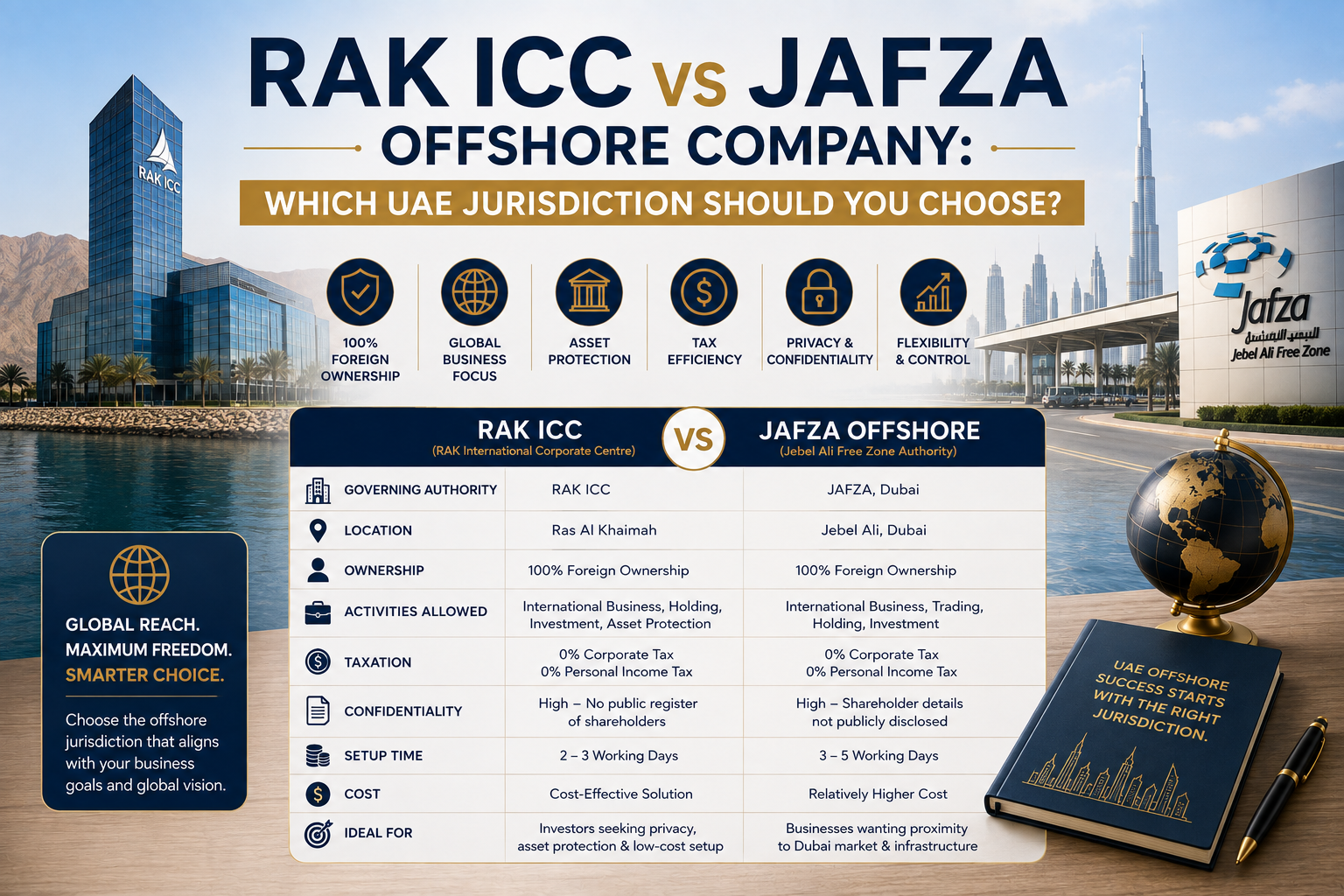
RAK ICC vs JAFZA Offshore: Quick Comparison
| Feature |
RAK ICC |
JAFZA Offshore |
| Location |
Ras Al Khaimah, UAE |
Dubai, UAE |
| International holding |
Yes |
Yes |
| Holding companies |
Suitable |
Suitable |
| International investments |
Suitable |
Suitable depending on structure |
| Real estate structures |
Can be used for eligible assets |
Relevant for certain Dubai property structures |
| Family wealth planning |
Strong potential use case |
May be considered depending on objectives |
| Special-purpose structures |
Suitable |
Can be suitable |
| Operating business in UAE |
Not a substitute for an operating licence |
Not a substitute for an operating licence |
| Registered agent |
Required under applicable framework |
Required |
| Best suited for |
International corporate structuring and holding |
International holding, Dubai-linked assets and offshore structures |
The appropriate choice depends on the specific circumstances of the investor or business.
1. RAK ICC vs JAFZA Offshore for Holding Companies
Both structures can be considered for holding company purposes.
A typical structure may look like:
Investor
↓
RAK ICC / JAFZA Offshore Holding Company
↓
Subsidiary A
Subsidiary B
Investment C
RAK ICC specifically identifies holding companies and special-purpose vehicles among its corporate uses.
JAFZA also identifies holding companies as one of the purposes for which offshore companies may be established.
Therefore, both can potentially serve holding-company objectives, but the details of the underlying assets and business structure should guide the decision.
2. RAK ICC vs JAFZA Offshore for International Business
International businesses often need a corporate vehicle to manage ownership interests across different countries.
RAK ICC can be used for international business structures, investment holding, and corporate ownership.
JAFZA Offshore can also support international business purposes, including international trade and consulting activities.
However, investors should distinguish between holding or structuring international business interests and actually conducting commercial activities in the UAE.
An offshore company should not automatically be treated as a substitute for a mainland or free zone operating company.
3. RAK ICC vs JAFZA Offshore for Property Ownership
Property ownership can be an important consideration for some investors.
JAFZA states that its offshore companies can be used for real estate ownership, subject to the relevant requirements and restrictions.
RAK ICC structures can also be used in certain holding structures involving real estate and other assets.
However, property ownership rules can vary depending on:
- Property location
- Property type
- Ownership restrictions
- Developer requirements
- Financing arrangements
- Applicable UAE regulations
Investors should verify eligibility before purchasing or transferring property through an offshore structure.
4. RAK ICC vs JAFZA Offshore for Asset Holding
Investors may establish holding structures to organise ownership of eligible assets.
A RAK ICC company can potentially hold:
- Shares
- Investments
- Subsidiaries
- Certain property interests
- Other eligible assets
JAFZA Offshore may also be relevant for holding companies and certain assets.
The key question is not simply which jurisdiction allows an offshore company, but whether the specific asset can be appropriately held through the proposed structure.
5. RAK ICC vs JAFZA Offshore for Family Wealth Planning
Families with multiple investments or business interests may consider corporate structures as part of longer-term wealth planning.
A RAK ICC structure can be particularly relevant where the objective involves:
- Family investment holding
- Succession planning
- Ownership consolidation
- Family-office structures
- Long-term asset management
JAFZA Offshore may also be considered depending on the family's objectives and assets.
For inheritance and succession matters, investors should obtain appropriate legal advice because the relevant rules may extend beyond the UAE.
6. Ownership and Foreign Investors
International investors generally want to know whether they can own their offshore company without a UAE national shareholder.
Both RAK ICC and JAFZA Offshore are designed for international corporate structures.
However, ownership documentation and due diligence requirements still apply.
Investors should be prepared to provide information concerning:
- Shareholders
- Directors
- Beneficial owners
- Source of funds
- Source of wealth
- Corporate ownership chains
The precise requirements depend on the structure and applicant.
7. Directors and Corporate Governance
Directors play an important role in both corporate structures.
Investors should consider:
- Who will serve as directors
- Where directors are based
- Their responsibilities
- Corporate decision-making
- Record keeping
- Ongoing compliance
A clear governance structure is particularly important for international companies with multiple shareholders or subsidiaries.
8. Banking Considerations
Banking is another major factor when comparing offshore structures.
A bank may review:
- Company activities
- Shareholders
- Beneficial owners
- Directors
- Expected transactions
- Source of funds
- Source of wealth
- Countries involved
The choice between RAK ICC and JAFZA Offshore should therefore be considered alongside the company's intended banking requirements.
Importantly, incorporation does not guarantee bank account approval.
9. Tax Considerations
Neither structure should be selected solely because an investor expects it to provide a particular tax outcome.
Businesses should consider:
- UAE corporate tax
- Foreign tax obligations
- Withholding taxes
- Tax residence
- Double taxation agreements
- Transfer pricing where applicable
- Reporting requirements
The tax treatment depends on the company's activities, ownership, assets, and relevant jurisdictions.
For international structures, professional tax advice should be obtained before implementation.
10. Compliance and Administration
Both structures require appropriate corporate administration.
Investors should consider ongoing responsibilities such as:
- Maintaining corporate records
- Updating beneficial ownership information
- Meeting annual requirements
- Maintaining registered agent arrangements
- Keeping ownership documents current
- Meeting applicable reporting obligations
The cost of maintaining a structure should be considered alongside the initial incorporation cost.
RAK ICC vs JAFZA Offshore: Which Is Better for You?
There is no single answer.
RAK ICC may be worth considering if you need:
- An international holding structure
- Investment holding
- A special-purpose vehicle
- Family wealth structuring
- Succession planning
- Multiple subsidiary ownership
- A flexible international corporate framework
JAFZA Offshore may be worth considering if you need:
- A Dubai-based offshore structure
- International holding
- Certain real estate ownership structures
- International trade-related structuring
- Intellectual property holding
- International consulting structures
The final decision should be based on the specific assets, business activities, ownership, and long-term objectives.
RAK ICC vs JAFZA Offshore: Example Structures
Example 1: International Holding Company
Investor
↓
RAK ICC Holding Company
↓
International Subsidiary A
International Subsidiary B
This may suit an investor looking for a centralised international ownership structure.
Example 2: Dubai Property Structure
Investor
↓
JAFZA Offshore Company
↓
Eligible Dubai Property
The feasibility of the structure depends on the property, ownership rules, and relevant approvals.
Example 3: Family Investment Structure
Family
↓
RAK ICC Company
↓
Investment Portfolio
Business Interests
Subsidiaries
A structure like this may support centralised ownership and longer-term succession planning.
Common Mistakes When Choosing Between RAK ICC and JAFZA Offshore
Choosing Based Only on Price
The lowest formation cost may not produce the most suitable long-term structure.
Ignoring the Company's Purpose
The intended purpose should determine the structure, not the other way around.
Assuming Both Structures Are Identical
Although both support offshore corporate structures, their frameworks and practical use cases differ.
Ignoring Tax Implications
International ownership can create tax obligations in multiple jurisdictions.
Forgetting About Banking
Banking requirements should be evaluated before incorporation.
Using an Offshore Company for Local Trading
An offshore company should not automatically be used to conduct ordinary UAE commercial activities without the appropriate licence.
How to Choose the Right UAE Offshore Structure
Before making a decision, investors should answer five questions:
1. What is the main purpose?
Holding, investment, property, international business, or succession planning?
2. What assets will the company own?
Shares, subsidiaries, property, intellectual property, or investments?
3. Where are the assets located?
Dubai, another UAE emirate, or overseas?
4. Will the company conduct actual operations?
If yes, determine whether an operating licence is required.
5. What are the long-term objectives?
Consider future investments, acquisitions, ownership changes, succession, and expansion.
These questions can help narrow down the most appropriate structure.
How DBTA Can Help
Choosing between RAK ICC and JAFZA Offshore requires careful consideration of the company's purpose, ownership, assets, banking requirements, and long-term objectives.
DBTA provides offshore company formation services in Dubai and the UAE, helping investors and businesses understand available structures and navigate the incorporation process.
For complex tax, legal, property, or cross-border matters, businesses should also seek advice from appropriately qualified professionals.
Conclusion
When comparing RAK ICC vs JAFZA offshore company structures, investors should focus on their actual business requirements rather than simply choosing the most popular or least expensive option.
RAK ICC may be particularly relevant for international holding, investment, family wealth, and corporate structuring, while JAFZA Offshore can be relevant for Dubai-linked offshore structures, holding arrangements, and certain property and international business purposes.
The right choice ultimately depends on the company's objectives, assets, ownership, banking needs, and future plans. Dubai Business and Tax Advisors (DBTA) can assist investors with offshore company formation and help them understand the formation process and available corporate structuring options in the UAE.




 Arabic
 French
 Spanish
 Portuguese
 Deutsch
 Turkish
 Dutch
Dutch
 Italiano
 Russian
 Romaian
 Portuguese (Brazil)
 Greek
Greek